27 June 2026
How to practise so it actually sticks
Most people do not practise. They play. They sit down, run through the piece from the top, hit the same wall in bar nine, start again from the top, and finish having rehearsed bars one to eight for the hundredth time and bar nine not at all.
Practice is a skill of its own, and nobody is born with it. Here is what works.
Short and often beats long and rare
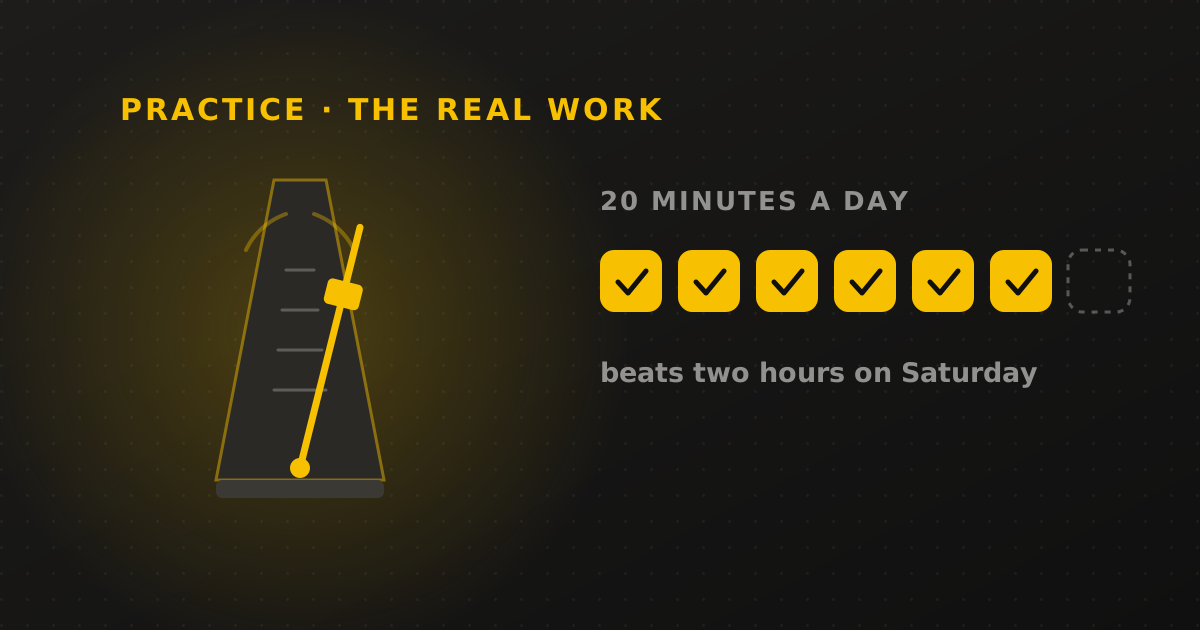
Twenty minutes a day will take you further than two hours on a Saturday. Skills consolidate in the gaps between sessions, not during them — which means five short sessions give your playing five chances to settle, and one long session gives it one.
If you can only manage ten minutes, do ten minutes. A short session you actually do is infinitely better than the hour you keep meaning to schedule.
Practise what you cannot play
This sounds obvious and almost nobody does it. Playing a piece from the top is rehearsal, not practice, and it is enjoyable precisely because it is mostly made of things you have already mastered.
Find the bar that breaks. Practise that. When it works, practise the bar before it and the bar after, so the join holds. The rest of the piece does not need you today.
Slow down further than feels sensible
Play it slowly enough that you cannot make a mistake. That is the correct speed — and it is almost always slower than you think.
Mistakes are not neutral events you can rinse away with repetition. Every time you play a wrong note, you strengthen it slightly. Speed is a by-product of accuracy, and it arrives on its own once the accuracy is reliable. Chasing it directly just makes fast mistakes.
Use a metronome, even though you don't want to
Nobody enjoys the metronome. It is still the fastest way to find out that your timing is not what you believe it is — most students unconsciously speed up in easy passages and slow down in hard ones, and cannot hear themselves doing it.
Set it slow. Play the passage cleanly three times in a row, then move it up a notch. If you miss, drop back down. Progress is not linear and that is fine.
Practise hands separately for longer than you want to
When a passage will not come together, it is usually because one hand is not secure on its own. Playing them together just hides which one. Take them apart, fix the weak one, then rejoin — slowly.
End on something that works
Finish every session by playing something you can already play well. Two reasons: you leave with the sound of playing well in your ears, and you associate practice with satisfaction rather than struggle. Motivation is built by sessions that end well, and motivation is what gets you back tomorrow.
A twenty-minute session that works
- 3 minutes — warm up. Scales, or anything that gets your hands moving.
- 10 minutes — the hard part. One passage, slowly, hands apart if needed, with a metronome.
- 5 minutes — the current piece, in context, at whatever tempo stays clean.
- 2 minutes — play something you love, badly or well. This one is not optional.
Write down what you did
Not what you played — what changed. "Bar 9 finally clean at 60bpm" tells your next session where to start and tells you, on the days it feels hopeless, that it isn't.
Our students log practice in the JMG portal so their teacher can see the week between lessons, not just the hour in front of them. It is the least glamorous feature we built and one of the most useful.
The honest summary
Practise most days, even briefly. Work on what is broken rather than what is comfortable. Go slower than feels reasonable. Finish happy.
Do that for a year and you will be a different player. Book a free trial lesson and we will build you a practice plan worth following.
Want to learn this for real?
Book a free trial lesson with JMG Music in Harare or online.
Book a free trial