3 July 2026
How long does it take to learn piano?
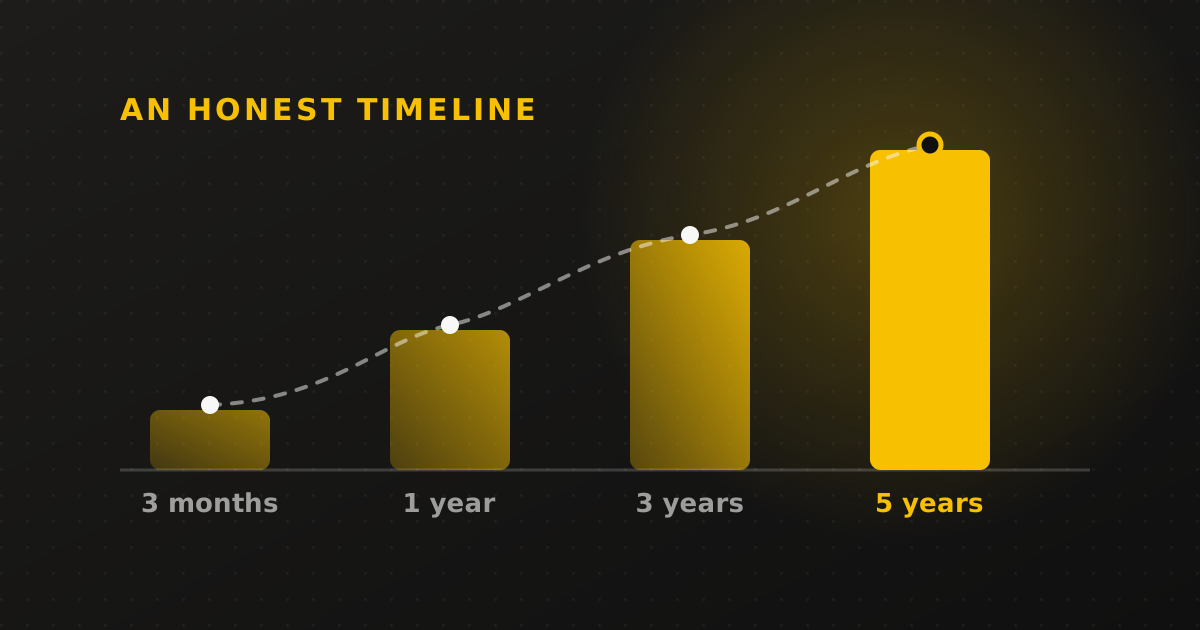
"How long will it take?" is a fair question with an unsatisfying answer: it depends on what you want to play, and far more on how you practise than on how gifted you are. Here is an honest timeline, based on what we see in the studio.
The first three months
With a weekly lesson and twenty minutes of practice most days, a beginner can expect to read simple notation, play with both hands together on straightforward material, and get recognisably through a few simple songs.
This stage feels slower than people expect, because the hands are learning to work independently — genuinely difficult, and unrelated to musical talent. Adults often find it harder than children here, and then overtake them later.
Six months to a year
This is where it starts to feel like playing rather than exercises. Most students can play pieces they actually chose, use the sustain pedal without thinking, read reasonably fluently in common keys, and play basic chord progressions by ear.
For gospel and worship students, this is usually the point where you can hold a simple part in a live setting. That milestone tends to arrive earlier than classical students expect, because chord playing gets you into a room with other musicians sooner.
Two to three years
Comfortable intermediate territory. You can learn a new piece without help, improvise within a key, transpose on the fly, and play with other musicians without rehearsing every bar first. Most students who reach here stop counting years and start choosing repertoire.
Five years and beyond
Advanced repertoire, fluent improvisation, and the ability to teach yourself. The ceiling stops being technique and starts being taste.
What actually changes the pace
Four things move the needle, and only one of them is talent.
Practice frequency beats practice length
Twenty minutes a day beats three hours on Saturday, and it is not close. Skills consolidate between sessions, so five short sessions build more than one long one. This is the single biggest predictor of progress we see.
Having an instrument at home
A student who cannot practise between lessons is paying to stand still. Any touch-sensitive keyboard is enough to start — see our buying guide.
Playing music you like
Motivation is not a character trait, it is a consequence. Students working on music they chose practise more, and practising more is the whole game.
Being corrected early
Bad habits — collapsed wrists, tense shoulders, guessing at rhythm — are quick to fix in week three and stubborn in year three. This is most of what a teacher is for.
Children and adults learn differently
Children absorb technique and ear training more readily and rarely worry about sounding bad, which helps enormously. Adults understand structure faster, practise more deliberately, and can reason about theory — but they judge themselves harshly and quit more easily.
Adults are not too late. The adult beginners who succeed are simply the ones who accepted that the first three months feel awkward for everyone.
A realistic answer
If you practise most days and take a weekly lesson, you will play something you are proud of within a year. Not a concerto — but a real piece of music, properly. That is the milestone worth aiming at.
Book a free trial lesson and we will give you an honest read on what your first year looks like.
Want to learn this for real?
Book a free trial lesson with JMG Music in Harare or online.
Book a free trial